Beech Leaf Liqueur
How to make Beech Leaf Liqueur or Beech Leaf Noyau
Beech leaf liqueur, sometimes called beech leaf noyau, is a sweet woodland drink made by infusing young beech leaves in gin, then after three weeks, adding sugar syrup and a little brandy. The best flavour comes from very young, soft, bright green leaves picked in spring.
It couldn’t be more simple. Serve neat or over ice.

Ingredients
- Young beech leaves
- Gin (700ml)
- White sugar (225g) plus 300ml water to make the sugar syrup
- Brandy (200ml)
- A large sterilised jar with a lid
- Straining cloth or fine sieve
- Sterilised bottles
Method
- Collect young beech leaves in spring, choosing soft, pale green leaves.
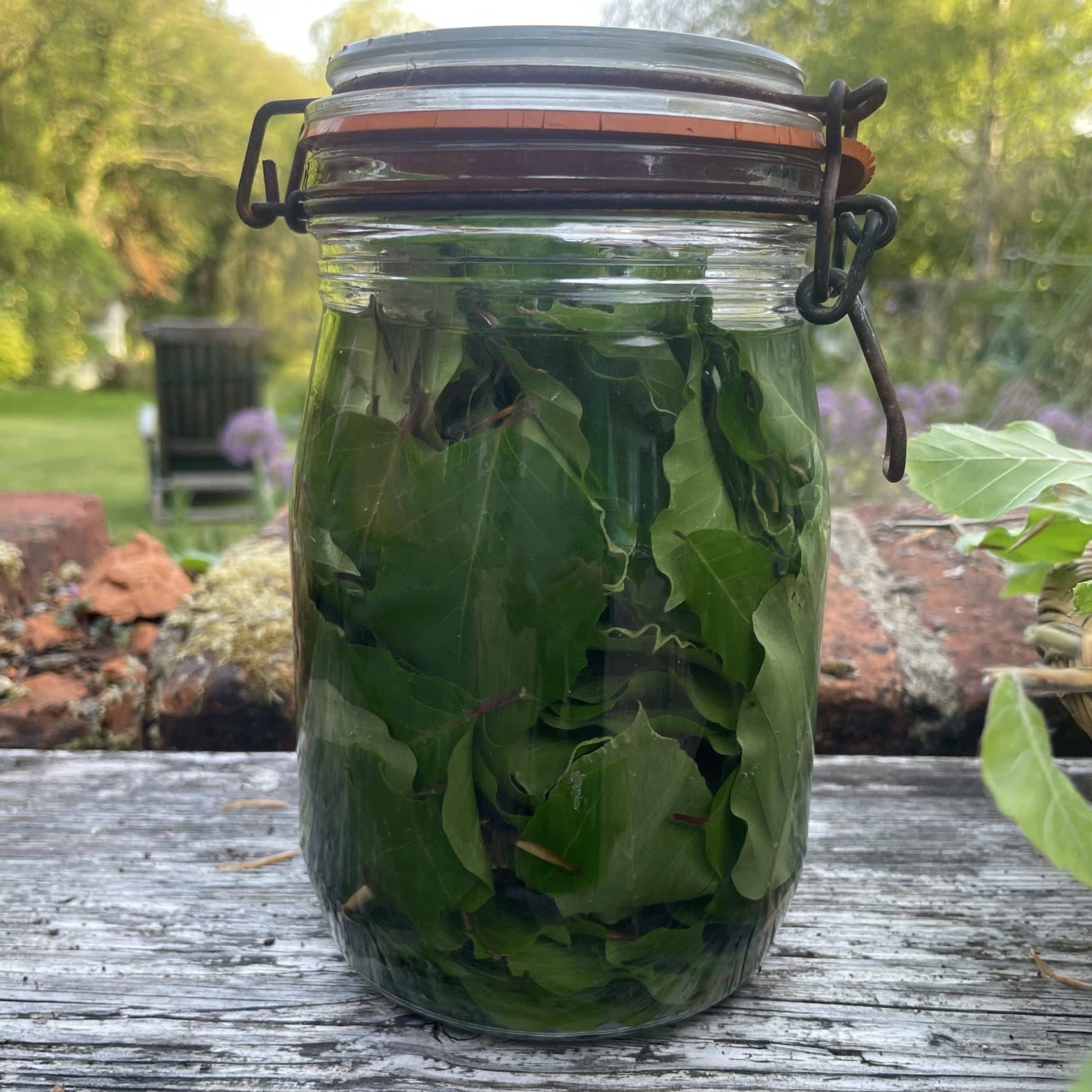
- Pack the leaves loosely into a jar and cover them completely with gin.
- Leave the jar in a cool, dark place for about 3 weeks, shaking it occasionally.
- Strain off the gin and discard the leaves.
- Make a sugar syrup by gently heating sugar and water until dissolved, then let it cool.
- Mix the infused gin with the syrup and add brandy.
- Bottle the liqueur and leave it to mature for a few weeks or longer before drinking
Tips and Tricks
Harvesting tips
Pick only young leaves that are soft, young and freshly unfurled: the best time to do this is late April and throughout May. Older beech leaves won’t yield the desired flavour. You don’t need many leaves, but take a little from many branches rather than stripping one tree, and avoid damaging young trees. You can use the fresh young leaves of a common (green) beech or a copper beech.
Beech Tree Identification
The common beech (Fagus sylvatica) has a smooth, thin, grey bark with slight horizontal etchings. The young leaves are lime green with silky hairs, 4-9cm long, oval, pointed at the top, with a distinctive wavy edge. Beech trees are often grown as hedging. Beech woodland is shady: mature trees can grow to more than 40m and have a dense canopy. You can also use the young leaves of the copper beech (Fagus sylvatica f. Purpurea) for this recipe. The red to purple leaves mark a clear difference in comparison to the common beech.
Not to be confused with the hornbeam – beech leaves have wavy edges with small hairs as opposed to the serrated margins of hornbeam.
Look at an authoritative source such as the Woodland Trust website